Week 9

Libraries SA. (2012, July 16). One Card Network – What’s it all about? (South Australia’s public libraries) [Video]. YouTube. https://www.youtube.com/watch?v=fNUQcVhpmqQ

As shown in the YouTube clip, South Australian libraries are one example where a state-wide LMS has been implemented. This presents both advantages and disadvantages.

A country library

Surveys following Libraries SA One Card network implementation highlight that one advantage is smaller libraries have access to a resource which otherwise would be out of reach (Libraries SA, 2014). However, country libraries may have limited on-site support and training compared to metro areas if the LMS provider is located centrally.

Library user

As the video highlights, a state-wide LMS allows access to a much larger collection and offers patrons flexibility and convenience as they can borrow and return at any library. One drawback though is the potential confusion surrounding different borrowing rules between libraries. 

Library space

Finally, a state-wide LMS can free up physical space required to hold collections, given that libraries can draw on other libraries’ collections. Again, using Libraries SA as a case study, 42% of libraries stated they are more considerate of the number of copies they purchase due to having a state-wide LMS (Libraries SA, 2014). However, if less physical copies are available there is potential to alienate users who prefer to browse in-person. 

Reference

Libraries SA. (2014). ILMS outcomes summary brochure. https://www.libraries.sa.gov.au/custom/web/PLS/1LMS_Outcomes_Summary_Brochure_-_A4.pdf

Week 8

Both articles by Gambrell (2015) and Piola (2018) highlight the importance of planned decisions about website design. These suggestions have been incorporated into the development of a new website, to (hopefully) avoid looking like the world’s worst website ever.

Exploration Media Group. (2020). Front page of website [Image, screen capture]. https://www.theworldsworstwebsiteever.com

Search bar

Each page will include a search bar as search is the primary action taken on a website (Gambrell, 2015). The search bar will be in the same prominent location to avoid confusion and will include the description ‘type your search here’ to set user’s expectations (Gambrell, 2015).

Simple navigation 

Gambrell (2015) recommends 5-6 primary navigation items whilst Piola (2018) suggests no more than 7. Limiting the navigation makes it more likely users can find what they are looking for (Piola, 2018). As such, six main navigation items (including the home page) will be used.

Plain English 

As recommended by both Gambrell (2015) and Piola (2018), text will be written using Plain English. Plain English lends itself to a better user experience as users are more likely to find what they are looking for (Marinakos, 2018). If the text is too complicated people could lose interest or become frustrated and leave the website.

Accessible

Following Gambrell’s (2015) suggestion, the website will be made as accessible as possible through appropriate colour contrast, a language translation feature and use of alt-text. This limits barriers for users.

Cut links 

Links should be kept to a minimum, particularly on the home page (Piola, 2018). One library website’s analysis found that often only a few links are used by patrons (Piola, 2018) therefore there will only be three main links and the search bar on the homepage.

References

Gambrell, K. (2015, December 8). 7 best practices for creating a user friendly library website. EBSCOpost. https://www.ebsco.com/blog/article/7-best-practices-for-creating-a-user-friendly-library-website

Marinakos, C. (2018, October 7). How we read online (and 6 skills every web writer needs to master). The Writing Cooperative. https://writingcooperative.com/how-we-read-online-and-6-tips-every-web-writer-needs-to-know-88302c09521

Piola. (2018, March 27). 8 tips to improve your library’s website design. https://meetpiola.com/8-tips-to-improve-your-librarys-website-design/

Week 6

The Art Gallery of South Australia website

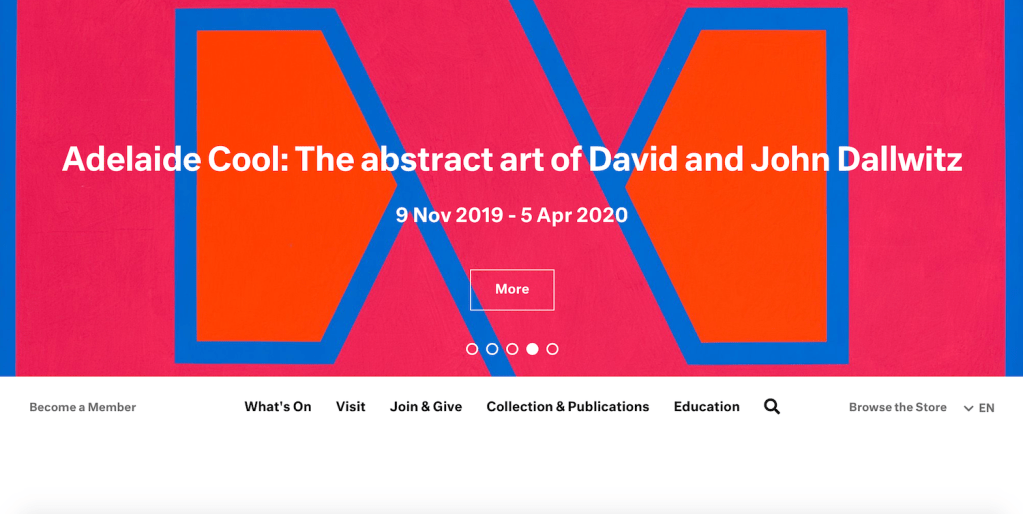
Art Gallery of South Australia. (2020). Front page of website [Image, screen capture]. https://www.agsa.sa.gov.au

This week’s post looks at the Art Gallery of South Australia’s website. The site implements an ambiguous scheme and a hierarchical structure. The navigation bar is located at the top and scrolls with the page which is useful as you can always navigate to another section regardless of how far down the page you are. The type of hierarchy is broad and shallow as each page can be navigated to within a few clicks. It adheres to the ‘three click rule’ wherein users are able to find what they are looking for in three clicks or less, ultimately reducing the potential that they will abandon their search (U.S. Department of Health & Human Services, n.d.). The site also has breadcrumb navigation which helps orient the user to their location within the website. The branding on the home page is not immediately apparent when viewed on my browser. This is highlighted in the above image showing the default view when landing on the front page. Instead the institution name appears after scrolling further down the page. In terms of accessibility there are multiple languages available, but some errors were identified using the Web Accessibility Validation Evaluation tool (WebAIM, n.d.) including low contrast between text and background in sections and small text headings. This may limit the accessibility for people with a vision impairment. 

References

WebAIM. (n.d.). Web accessibility validation evaluation tool. https://wave.webaim.org/

U.S. Department of Health & Human Services. (n.d.). 3-click rule. https://www.usability.gov/what-and-why/glossary/3-click-rule.html#

Week 5

Photo by Christian Wiediger on Unsplash

https://www.abc.net.au/news/2017-08-10/ai-democracy-google-facebook/8782970?pfmredir=sm

The news article linked above poses the questions of what happens to democracy in a society increasingly reliant on algorithms. A key takeaway was the article’s concluding statement highlighting that this technology does have the capacity to assist in society just as it can be a hindrance if it is abused or used incorrectly. As examples throughout the article show, algorithms are fallible partly because they are created by humans and as such can reflect societal bias. This can in part be addressed through diversity in tech firms. As Arvanitakis et al. (2018) highlight in a similar article, “it matters who is writing the code because the code defines the algorithm, which makes the judgement on the basis of the data.” Additionally, popular algorithms can be gamed through search engine optimisation leading to a potential filter bubble (Arvanitakis, 2017). Digital literacy is one way to address this, ensuring that rather than accepting that the information is presented without bias, people are able to critically analyse this information. Given the impact algorithms can have on democracy and our society, universities should incorporate data ethics into courses just as ethics are a component in degrees such as Psychology and Medicine. Additionally, transparency and regulation can mitigate potential negative impacts. 

References

Arvanitakis, J. (2017, August 11). If Google and Facebook rely on opaque algorithms, what does that mean for democracy? ABC News. https://www.abc.net.au/news/2017-08-10/ai-democracy-google-facebook/8782970?pfmredir=sm

Arvanitakis, J., Francis, A., & Obst, O. (2018, June 22). Data ethics is more than just what we do with data, it’s also about who’s doing it. The Conversation. http://theconversation.com/data-ethics-is-more-than-just-what-we-do-with-data-its-also-about-whos-doing-it-98010

Wiediger, C. (2019). Google logo screen [Online image]. Unsplash. https://unsplash.com/photos/zhZydTyNMPg

Week 3

https://www.abc.net.au/news/2019-12-27/foster-library-first-in-victoria-to-open-24-hours-a-day/11777696

The article in the link above published by Maunder (2019) highlights the move for one Victorian public library to open 24/7, making it the first to do so in Victoria. This change reflects the community’s needs with many cited as being unable to access the library during traditional opening hours (Maunder, 2019). Likely the biggest security implication for libraries is potential misuse of facilities and resources (both physical and technological) as well as how patron safety is managed without staff present. Technology such as access cards and self-service capabilities help to mitigate these implications and facilitate the extended opening hours. Additionally, implementing induction and registration procedures ensures that patrons can use self-service facilities and are authorised to access the network. Library staff also note the presence of security cameras. However, as McBride (2017) highlights in a similar article, managing security in libraries is a delicate issue with a need to balance patron safety whilst avoiding making public libraries feel intimidating or unwelcoming due to security measures.

References 

Maunder, S. (2019, December 20). First library in Victoria to open 24 hours a day, seven days a week has town buzzing. ABC Gippsland. Retrieved from https://www.abc.net.au/news/2019-12-27/foster-library-first-in-victoria-to-open-24-hours-a-day/11777696

McBride, K. (2017, June 21). Librarians in the 21st century: We need to talk about library security. Literary Hub. Retrieved from https://lithub.com/librarians-in-the-21st-century-we-need-to-talk-about-library-security/

Image attribution

starline, ‘24/7 open signboard’, Freepik license https://www.freepikcompany.com/legal#nav-freepik Image source: Freepik https://www.freepik.com/

Week 2

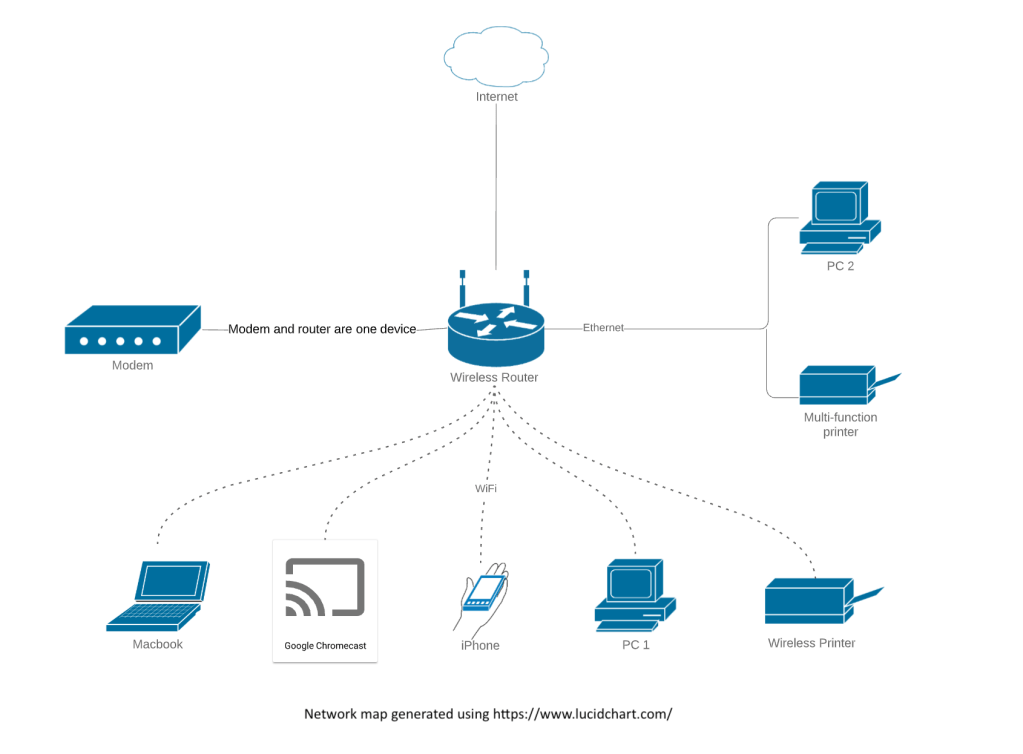
This diagram depicts a home network. Although shown as two units, the network uses one device that operates as a wireless router and modem suitable for NBN Fibre to the Premise. Devices are connected through ethernet or WiFi so is a hybrid home network topology (both wired and wireless) which is hosted on multiple servers. It is a shared network with other members of the household. The modem has 4 x gigabit ethernet LAN ports, a gigabit ethernet WAN port and a DSL port. One advantage of this type of network is the convenience of not being tethered to one location due to the availability of WiFi. However, there are limitations such as signal loss depending on location and proximity to the router. Security of WiFi is also a consideration, but this is mitigated through using a modem with Wireless Protected Access. Overall, it is an effective network setup suitable for the needs of a small household. 

Introduction

Hi everyone, my name is Kelly and I’m halfway through the DGIL (Library and Information Management) program.

I previously completed an Honours degree in Psychology and I enjoyed the research aspect of the degree so decided to pursue a career where I can help others develop their research and literacy skills.

In my spare time I enjoy baking, listening to music and gardening. I look forward to working with you all in the course!

Design a site like this with WordPress.com
Get started